India’s construction sector is booming, but beneath every project lies a document contractors know better than developers: the Bill of Quantities. When manipulated, it quietly drains your budget through BOQ manipulation in construction.
MoSPI’s February 2024 report found that of 1,902 monitored infrastructure projects, 443 saw cost overruns over Rs 4.92 lakh crore, an 18.19% excess over sanctioned budgets. Much of this construction cost overrun originates at the billing stage through bill of quantities fraud. Here are five contractor billing fraud tactics every developer in India must know.
5 Tactics Contractors Use to Inflate Bills
TACTIC 01
Quantity Inflation — Billing More Than What’s Built

The most widespread form of BOQ manipulation involves overstating measured quantities in Running Account (RA) bills. Multiplied across hundreds of items and multiple floors, this quantity creep can add 8–15% to a project’s civil cost without triggering any alarm bells on site.
⚠ Common in high-volume repetitive items: earthwork, flooring, masonry, reinforcement steel, and concrete.
TACTIC 02
Specification Substitution — Premium Rates, Inferior Materials
Contractors bill at BOQ rates for Grade M30 concrete or ISI-marked steel while deploying lower-grade materials on site. Since billing and material procurement are rarely cross-verified by the developer’s team, the rate remains premium but the quality does not.
⚠ Particularly dangerous in structural elements — concealed once formwork is stripped.
TACTIC 03
Front-Loading Bills — Getting Paid Before Earning It
Front-loading inflates early-stage RA bills to claim disproportionately high payment relative to actual work done. A contractor who has completed 20% of physical work will bill for 40%, arguing that mobilisation and “difficult early work” justify it. Once cash is received the pace slows and leverage shifts.
⚠ Creates cash flow leverage for contractors — and financial risk for developers.
TACTIC 04
Ambiguous Variation Orders — Turning Scope Creep Into Cash
Variation orders (VOs) are a legitimate tool for managing design changes. But contractors exploit vaguely worded BOQ items, a form of variation order fraud, to raise claims for work already included in the original scope.
⚠ Poor BOQ drafting creates 15–20% in variation claim exposure on an average project.
TACTIC 05
Duplicate and Phantom Items — Billing for Work Done Twice
In complex multi-trade projects, the same item can appear under different BOQ heads — once under civil works and again under finishing works. Phantom billing goes further with claims submitted for work never executed at all.
⚠ Difficult to detect without cross-referencing BOQ against actual site measurement records.
“An inaccurate or unaudited BOQ is not just a paperwork problem — it is a financial liability worth 10–30% of your total project value.” CONSTRUCTION ESTIMATOR INDIA, APRIL 2026 |
Why India-Specific Risks Make This Worse
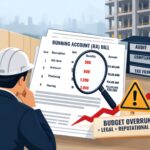
India’s construction landscape compounds these risks. RERA now mandates cost transparency to homebuyers, making developer budget overruns a legal and reputational issue. GST compliance requires itemised billing, yet many RA bills still lack the granularity that would make manipulation detectable during a tax audit.
With over 764 infrastructure projects delayed as of February 2024, most developers rely on project management teams to verify contractor bills which lack independent quantity surveying expertise.
The Solution: Independent Quantity and Billing Audits
This is precisely where a third-party construction billing audit pays for itself many times over. CQRA’s Quantity and Billing Audit service deploys experienced quantity surveyors to physically measure completed work, cross-verify RA bills against approved BOQ items, and flag anomalies before payments are released.
Protect Your Project Budget with CQRA – Contact us today for a Consultation
Sources
- Ministry of Statistics and Programme Implementation (MoSPI). Infrastructure Projects Status Report, February 2024. mospi.gov.in
- Construction Estimator India. “What is BOQ in Construction?” constructionestimatorindia.com, April 2026.
- Hindustan Times. “443 Infra Projects Hit by ₹4.92 Lakh Crore Cost Overrun in Feb.” April 2024.
- Indian Academy of Sciences. “Identifying Factors Causing Cost Overrun of Construction Projects in India.” Sadhanā, Vol. 42.
- CQRA Private Limited. Quantity and Billing Audit Services. cqra.com/services/quantity-and-billing-audits/
Contact CQRA to know how we can collaborate.
Website: www.cqra.com
Email: marketing@cqra.acts-int.com
Contact: +91 9112232323