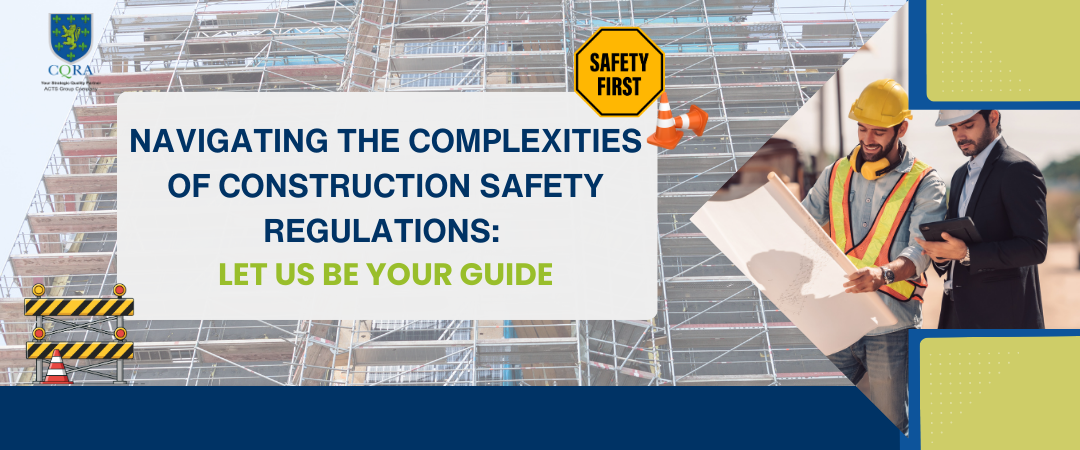
Construction safety regulations can be complex for companies to navigate and even for employees to follow. The case of a top company official not wearing a safety helmet while visiting an under-construction project, and setting a bad example as someone in a leadership position proves that managing safety can be an onerous task for company managements. While these issues need sustained safety awareness drives there are certain aspects that managers can focus on in order to navigate the complexities of construction safety regulations. Let’s find out what these are.
Decoding Legal Provisions – Knowledge of detailed provisions in Indian law pertaining to worker safety as well as environment protection is an important requirement. Some of these the pertinent laws in the Indian scenario are Building and Other Construction Workers Act, 1996; Occupational Safety, Health, and Working Conditions Code, 2020; The Indian Electricity Act 2022; The Environment Protection Act 2023; National Building Code of India 2016; The Contract Labor (Regulation and Abolition) Act, 2017.
Appoint Safety Officers and Committees – Indian laws generally stipulate the appointment of a Safety Officer on site and forming a Safety Committee for sites with 500 or more workers. There can be lower thresholds of worker numbers depending on how risk ridden the work environment is. Now contractors may use this provision as an excuse and not have safety officers, citing a less worker strength. Managers must employ standards that offer the workers optimum safety cover in terms of surveillance and practice.
Follow IS Codes for Equipment – Companies tend to avoid spending on good quality safety equipment and assets. Instead they opt for low quality safety nets, guardrails and harnesses that do not meet the required IS code for these items. An important part of navigating safety regulations is following the designated codes for safety equipment and not compromising on the safety of your workforce.
Conduct Thorough Contractor Evaluations – The management committee must perform proper contractor evaluations before hiring them and avoid going for the L1 bidder. Employing a value driven approach towards contractor recruitment helps companies navigate safety rules at site. L1 contractors have most likely truncated their budgets, with safety systems taking the biggest hit. And poor safety governance hampers the project’s credibility.
Make Safety Audits Non-Negotiable – Safety Auditing is the lynchpin of navigating construction safety. Safety audits by CQRA, a third party agency enables risk mitigation and a better awareness of safety requirements on site. For corrective actions, the auditors further perform root cause analysis and risk assessments.
Analyze NCs for Corrective Action – If auditor finds a worker operating at a height on the site without the requisite safety equipment, the root cause analysis tries to understand the underlying cause like behavioral issue, lack of supervision, non availability of safety harness etc. Implementing a three level supervision system for jobs where the contractor issues work permits before the work begins, the client engineer reviews it and project manager approves it, ensure a watertight system with safety at its core.
CQRA’s Safety experts have observed that navigating safety regulations are not just about following rules, codes and legal provisions but also addressing Behavioral Based Safety (BBS) issues of workers. To know how to inculcate a robust safety culture on the site that focuses on implementation of best practices, contact CQRA.
Contact CQRA to know more about our services.
Website: www.cqra.com
Email: marketing@cqra.acts-int.com
Contact: +91 9112232323