
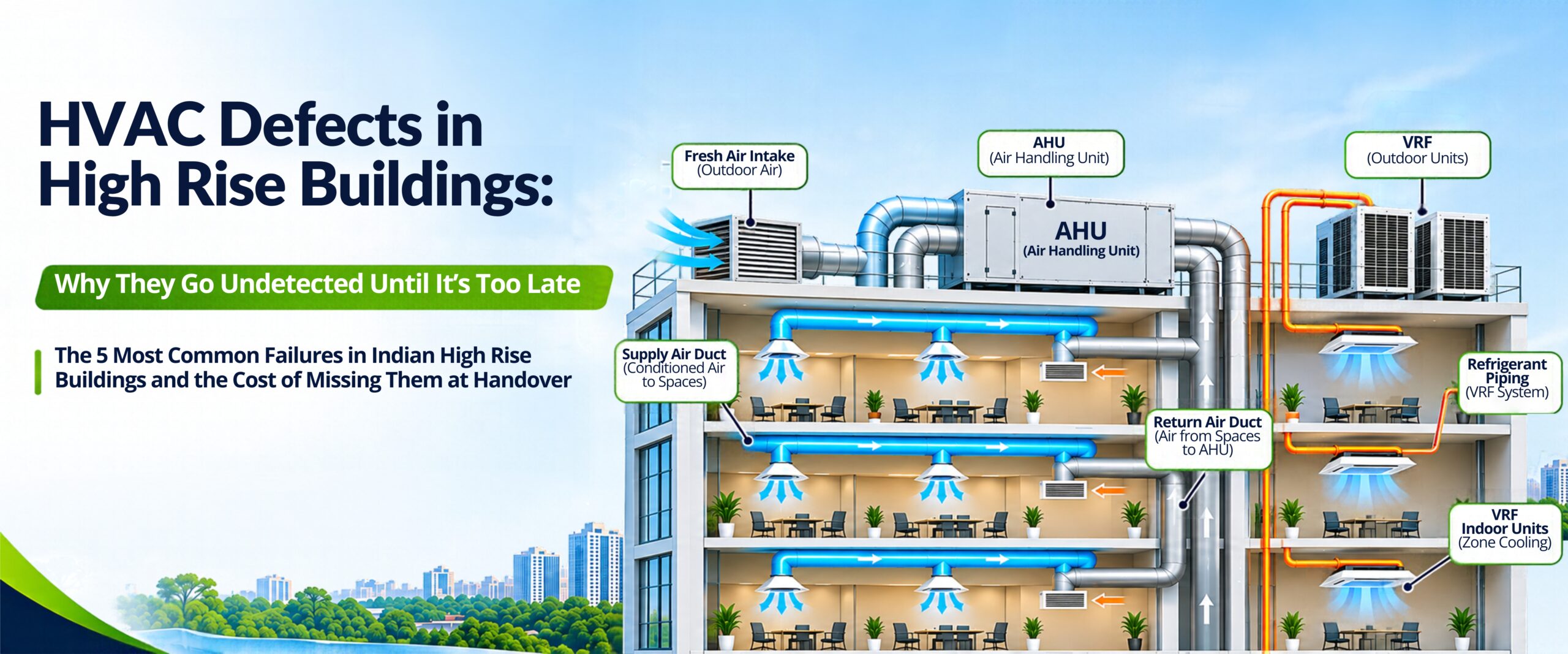
The 5 Most Common Failures in Indian High Rise Buildings and the Cost of Missing Them at Handover
HVAC systems account for an estimated 50 to 60 percent of total energy consumption in India’s commercial buildings and HVAC defects in high rise buildings carry a real cost when they go unnoticed. Hidden defects that carry into occupation compound fast, bringing unhappy residents, rising costs, expensive rectification, and avoidable RERA complaints. Here are the five defects most commonly found at handover, all detectable beforehand, yet almost all missed.
1. Air Leaking Through Poorly Sealed Ducts
Gaps in ductwork allow conditioned air to escape into ceiling voids rather than reach the rooms it was designed for. Industry research indicates losses of 20 to 30 percent are common. In Indian high rise buildings, where duct runs travel across multiple floors through unconditioned shafts the result is uneven cooling, overworked chillers, and higher electricity bills.
2. Uneven Cooling Across Floors and Rooms

Every construction management platform depends on the quality of data being entered. A digital checklist is only as reliable as the inspector completing it. An NC tracking system only captures what someone chooses to flag.
Without formal airflow balancing before handover, some zones receive too much conditioned air and others far too little. This is not a design failure but an HVAC commissioning failure in India which is often skipped or left to the installing contractor to self certify. Independent verification does not happen on most projects.
3. Incorrect Refrigerant Levels in VRF Systems
VRF systems now dominate high rise residential towers in India, but they are highly sensitive to refrigerant charge. Too little causes longer run cycles and premature compressor failure and too much risks serious mechanical damage. Getting the charge right across a multi branched network demands precise measurement, a step often compressed under deadline pressure that surfaces as complaints within weeks and compressor failures within years.
4. Building Controls That Are Installed But Not Commissioned
Most premium high rises specify Building Management Systems, but an uncommissioned BMS is effectively useless. Sensors read wrong values, schedules stay at factory defaults, and HVAC fire interlocks go unverified. Proper HVAC testing and commissioning in India would catch this before handover, yet screens light up and everything looks fine on a walkthrough. The gaps surface only after occupation as inconsistent comfort and unexplained energy use.
5. Insufficient Fresh Air Supply
In a well sealed high rise, HVAC is the only source of fresh air. Undersized, stuck, or misconfigured fresh air dampers mean residents breathe recirculated air, with well documented effects including fatigue, headaches, elevated carbon dioxide, and humidity discomfort.
Why Do These Defects Consistently Go Undetected?

The most effective deployments of construction technology share a common feature being that the people operating the platform are independent of the contractor organization. This is the basis on which CQRA structures its technology deployment.
HVAC systems are large, complex, and buried inside finished structures by handover. Contractors self certify their own work and project managers under delivery pressure rarely have specialist MEP resources to verify commissioning independently. A visual inspection of a running AC unit reveals nothing about design specification. Catching these defects needs instruments, trained engineers, and a structured construction MEP audit in India, run by unbiased experts.
Catching Defects Before They Become Complaints
The only reliable way to confirm an HVAC system performs as designed is building HVAC inspection before handover, carried out not by the installing contractor or the site team, but by an accredited third party with the instruments to measure what cannot be seen. CQRA’s MEP inspection India services, alongside our Testing and Commissioning work, give developers and investors exactly this assurance so the building performs as promised from Day one.
Get Independent MEP Inspections from CQRA
Contact us today to consult our Experts.
Contact CQRA to know how we can collaborate.
Website: www.cqra.com
Email: marketing@cqra.acts-int.com
Contact: +91 9112232323