Effective Construction Quality Audits go beyond site inspections—they identify quality risks before they become defects.
When a building develops damp patches, leaks, and peeling paint after the first monsoon, the instinct is to blame poor workmanship or contractor supervision. That instinct is usually wrong.
Evidence from our quality team, gathered across audited projects over 15 years, shows construction defects are rarely created on site. For developers and PMCs managing construction at scale in India most quality failures are decided before work begins, in the choices made at the design, specification, and procurement stage.
Research from MIT College of Engineering, Pune found that 20 to 40% of site defects originate in planning and documentation errors, not execution. A further 54% link to insufficient supervision and unskilled workers, both outcomes of poor pre-construction onboarding.
Waje & Patil, “Cost of Poor Quality in Construction,” IOSR-JMCE, Pune University / MIT College of Engineering
The Construction Industry Institute (CII), studying 359 projects, puts direct rework costs at an average of 5% of project value, rising to 20% where quality management is weak. On a ₹50 crore project, that is ₹2.5 to 10 crore in avoidable spend, before RERA liability and delay penalties.
Where building defects actually originate
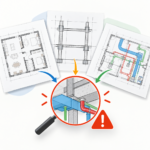
Drawing and Specification Gaps: Conflicts build up when structural, architectural, and MEP drawings are not cross-checked. Structural drawings missing cross-sectional details, or waterproofing specs listing generic BOQ materials, result in a flawed design, usually from inadequate design review.
Underspecified Materials: Materials without an approved vendor list or testing protocol are an open door for substitution. The PlanGrid/FMI report found inaccurate project information drives 22% of all rework, decided by procurement policy while the project is still on paper.
No Quality plans or SOPs for Contractors. Most contractors receive drawings and a scope, but few receive SOPs, Quality Assurance Plans (QAP), or Inspection and Test Plans (ITPs) as agreed quality standards. Without these, site quality rests on contractor judgment, with no real basis for inspection.
Five checks before work starts on site
|
PRE-CONSTRUCTION QUALITY AUDIT: QUICK CHECKLIST
|
Who should care, and why
Developers
RERA defect liability and handover disputes trace back to pre-construction decisions. Pre-construction audits mitigate that risk before possession.
PMCs & project heads
A pre-construction audit positions your team as risk managers and creates documented due diligence if disputes arise later.
Corporate real estate teams
For owned assets and fit-outs, early quality audits reduce post-occupancy maintenance costs and protect long-term asset value.
Lenders & investors
Construction quality audits are increasingly required as a disbursement condition for project finance in India. Early audits de-risk draw requests.
If more than two of these are unresolved when work starts, your defects are already in-built and scheduled. The site just hasn’t delivered them yet.
A pre-construction quality audit typically costs 0.1 to 0.3% of project value. The rework it prevents runs 5 to 20%. The intervention point is here, not after handover.
Get CQRA’s Pre-Construction Quality Audit before work starts on your next project
We work with developers, PMCs, and corporate real estate teams across India to review drawings, QAPs, BOQs, and contractor readiness, and create SOPs before execution begins. Most audits surface 8 to 15 critical risks, delivered with the assurance of CQRA’s expertise.
Contact CQRA to know how we can collaborate.
Website: www.cqra.com
Email: marketing@cqra.acts-int.com
Contact: +91 9112232323